The number of seats is not the same as the number of passengers served per hour. A commercial carousel passenger-throughput estimate should combine seat count with ride duration, loading and unloading time, operating discipline, expected seat occupancy, and planned downtime. This method gives amusement park operators and investors a realistic range for queue design and revenue modeling instead of an unsupported headline figure.
1. Use a Simple, Auditable Capacity Formula
Begin with theoretical hourly capacity: seats per cycle × cycles per hour. Cycles per hour equal 60 divided by the total cycle time in minutes. Total cycle time includes the actual ride program plus unloading, boarding, restraint or gate checks, announcements, and dispatch preparation.
For example, a four-minute total cycle produces 15 cycles per hour. At full occupancy, a 12-seat carousel would therefore have a theoretical capacity of 180 passengers per hour, while 24-, 30-, and 36-seat units would calculate to 360, 450, and 540 passengers. If the total cycle takes five minutes, the same models calculate to 144, 288, 360, and 432 passengers. These are planning examples, not guaranteed operating results.
2. Match Seat Count to the Venue’s Demand
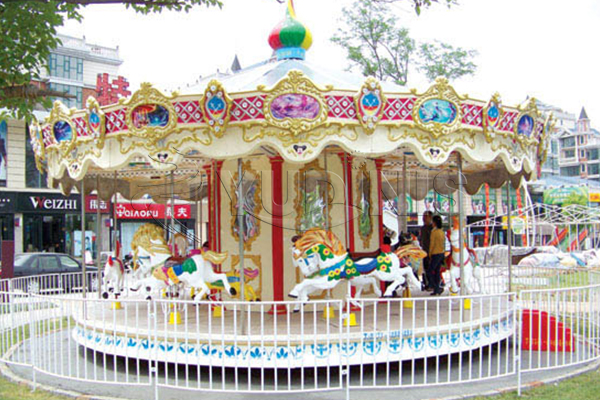
The commercial carousel range includes 12-, 16-, 24-, 30-, 36-, 38-, and 48-seat configurations. Small parks may prefer 12 or 16 seats where demand is modest and space is limited. Medium city parks and playgrounds can consider 24, 30, or 36 seats. Larger venues may evaluate 38- or 48-seat double-decker units when the guest mix, budget, circulation, and staffing support them.
For a high-demand single-level attraction, the 36-seat carousel capacity reference provides a useful comparison. The page lists 36 seats, 8/11 kW power, 380 V, and a customizable 10/12 m diameter. A larger seat count can raise theoretical capacity, but the surrounding queue, boarding gates, operator position, and exit path must be designed for the resulting flow.
3. Apply Occupancy and Availability Factors
Real operations rarely fill every seat on every dispatch. Parties may wait for adjacent horses, adults may supervise children without riding, and some figures may be temporarily unavailable. Apply an expected occupancy factor to the theoretical number. A 36-seat carousel with a four-minute total cycle has a theoretical 540 passengers per hour; at 85% average occupancy, the planning estimate becomes about 459.
Then apply an availability factor for routine pauses, cleaning, minor checks, weather interruptions, or operator relief. These adjustments turn maximum calculation into a more defensible operating estimate. The general idea is similar to network throughput: practical output can be lower than nominal capacity because the system contains constraints and delays.
4. Identify the Real Dispatch Bottleneck
The slowest recurring step controls hourly performance. It may be the ride program, but it may instead be boarding small children, checking gates, handling accessibility needs, processing tickets, or clearing the exit. Time each step during trial operations and record normal, busy, and difficult cycles.
Do not shorten required safety checks to pursue a higher number. Improve the process through clear signs, separate entrance and exit routes, organized grouping, trained operators, and well-positioned controls. A merry-go-round hourly capacity planning exercise should state all assumptions so the supplier and operator can challenge them before the business plan is approved.
5. Connect Capacity to Queue and Revenue Models
Hourly capacity affects more than ticket sales. It influences expected waiting time, queue length, staffing, guest satisfaction, and the distribution of visitors across nearby attractions. Model several scenarios: normal weekday demand, weekend peaks, holidays, and weather-affected periods. Compare arrival rates with practical throughput rather than assuming demand is evenly distributed.
Revenue models should also separate riders from paid admissions. A park may bundle rides into admission, sell individual tickets, or use time-based passes. Multiply realistic completed rides by the applicable revenue per rider, then test sensitivity to occupancy, downtime, and cycle time. This produces a more useful investment view than simply multiplying seats by an optimistic number of cycles.
6. Confirm the Number Through On-Site Testing
Before opening, train operators and run timed simulations with representative boarding groups. Confirm that the queue, gates, loading platform, announcements, and exit can support the planned cycle without congestion. After opening, compare actual hourly counts with the forecast and adjust staffing or guest-flow procedures where appropriate.
The DINIS carousel operations and selection team can discuss seat configurations and product dimensions, while the park operator remains responsible for local procedures and approvals. In conclusion, commercial carousel capacity is a range governed by seats, total cycle time, occupancy, availability, and dispatch practice. Use the current model data as the starting point: https://www.carouselmanufacturer.com/product/amusement-park-merry-go-round/
Leave a Reply