A train with several trailers looks more capable than a single carriage, but the extra capacity only works if the vehicle, the route and the station are designed for it. Buyers should settle those questions before the order is placed. This guide explains what to confirm for an amusement park train with multiple trailers.
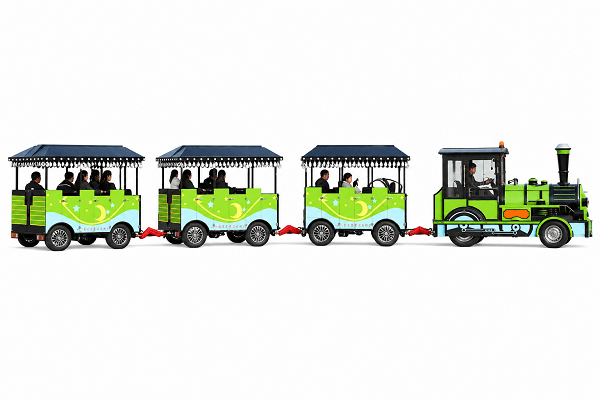
Confirm the Towing Capacity on Gradients
The locomotive must move the full set on the steepest part of the route, not only on the flat. Ask for the rated towing capacity with the planned number of trailers, the gradient limit at that load and the effect on acceleration and braking. Ask the manufacturer to state the figure for the exact trailer combination you intend to order, because capacity changes with every carriage added. A train that can pull three carriages on level ground may not be safe on a slope, especially when the carriages are full.
Check the Coupling System
Each coupling transfers load and movement between carriages, so the design has to suit the route and the operating conditions. Confirm the coupling type, the wear parts and the inspection procedure, and ask how the train behaves when one carriage is full and another is empty. A multi trailer park train needs couplings that are easy to check at every stop.
Plan the Station and Platform Length
A longer train needs a longer platform or a staged boarding procedure. Measure the space available at each stop and confirm that the train can stand clear of the walkway while guests board and leave. Where the platform cannot be extended, the operator may need to open only part of the train at each stop, which changes the loading time and the timetable.
Check Braking and Emergency Procedures
Braking performance changes with the number of carriages and the passenger load. Ask for the braking distance at the planned weight and for the procedure if a carriage has to be uncoupled. The operator should also confirm how guests are evacuated from the rear carriages if the train stops between stations.
Review the Route and Turning Areas
A longer train needs wider turns and more clearance at junctions. Walk the route with the proposed vehicle length in mind, then check the turning areas at each end. Reviewing the trackless train carriage options range shows how different configurations affect the turning radius, and the general principles of park transport are described in material on park transport systems.
Agree the Operating and Maintenance Cost
Finally, confirm the fuel or energy consumption, the maintenance interval and the spare parts for the additional carriages. A longer train carries more guests but also more weight, more brake wear and more inspection points. The total operating cost per passenger is the figure that decides whether the extra capacity is worthwhile.
Multiple trailers are a good investment when the towing capacity, couplings, platform length, braking, route clearance and operating cost are all confirmed in writing. Design the train as a system rather than a locomotive plus carriages. Operators can review the range from Dinis train configuration team and start from the product page at https://www.dinistrains.com/amusement-park-train-for-sale/.
Leave a Reply